Get the free Social Security guide.
You’re reading about Your IRA Is a Joint Account with Uncle Sam. Here's the Statement You Never See. Social Security touches almost all of it, and it is where the costliest mistakes happen. We’ll email you our guide, the taxable-benefit thresholds, the survivor-benefit trap and the claiming-age math, in plain English, plus an invite to the next free class. This is a public charity; there is nothing to buy.
The Retirement Literacy Foundation is a 501(c)(3) public charity (EIN 41-5062266). Free public education only. We don’t sell financial products and we don’t give individualized advice. We’ll email it to you. Unsubscribe any time.
The statement Fidelity should be sending you
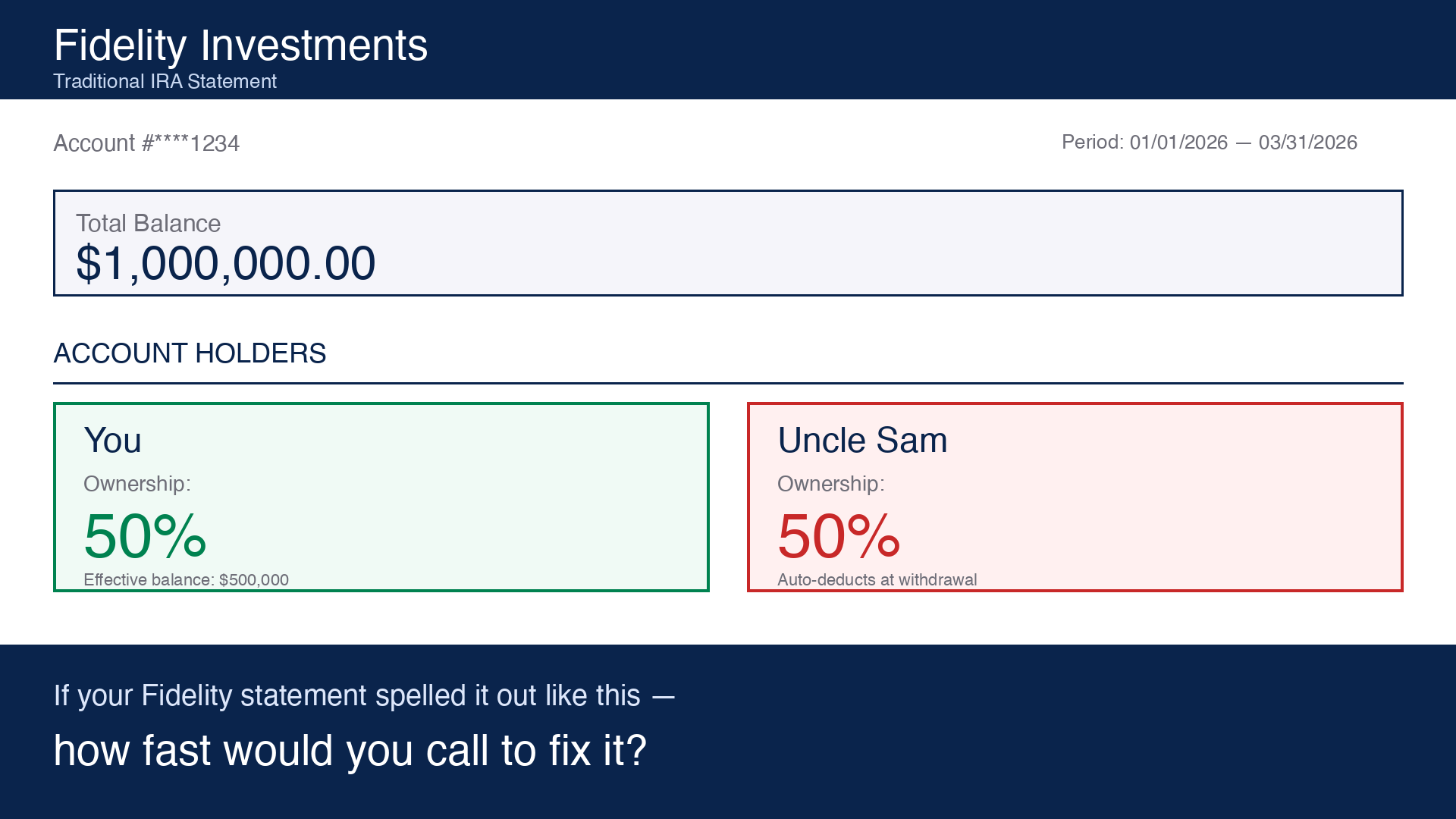
This is the mental model. Every dollar in your Traditional IRA was contributed pre-tax. You got the deduction in the year of contribution. The IRS, in exchange, owns a future claim on that money. When you (or your heirs) withdraw, the IRS collects.
For a typical retiree in the 22% to 24% federal bracket plus 8% to 13% California state tax, the IRS's effective share of every IRA withdrawal is 30% to 35%. For higher-bracket retirees, or for children who inherit under the SECURE Act 10-year rule and are themselves in peak earning years, the share can reach 40% to 50% or more.
Your $1,000,000 IRA balance is not $1,000,000 to you. It's more like $600,000 to $700,000 to you. The rest sits in a co-ownership stake held by the IRS, and that stake just doesn't appear on the statement.
Why this framing matters
Behavioral finance research consistently shows that people treat their gross IRA balance as if it were 100% theirs. They overspend in early retirement, underconvert to Roth in the low-bracket "valley" years between retirement and age 73, and leave large pre-tax balances to heirs who get hit by the 10-year compression rule.
If the statement showed the joint ownership clearly, every one of those behaviors would change. You'd treat the IRA as the joint account it actually is. You'd ask: "How do I reduce the co-owner's share before they collect more?"
The answer is Roth conversions, executed strategically in years when your tax bracket is lower than the bracket the money would otherwise be withdrawn at, either by you later, or by your heirs after death.
What a Roth conversion actually does
A Roth conversion moves a dollar from the joint Uncle Sam account into a 100%-yours Roth account, after paying the tax at today's rate. The dollar (minus the tax) now grows tax-free forever. No RMDs during your lifetime. No tax on withdrawals. Heirs inherit it Roth-style: no annual taxation, just a 10-year distribution window.
The math works whenever today's marginal tax rate is lower than the rate the money would otherwise be withdrawn at later. For most retirees between age 60 and 73, the "Roth conversion window", this is mathematically true by a meaningful margin.
The classic example
A 65-year-old couple with $1.2M in Traditional IRAs, $40K Social Security, no other income. They are in the 12% federal bracket. They can convert $80,000 per year to Roth, paying federal tax of roughly $7,500 plus state (2026 joint brackets, with $34,000 of their Social Security taxable and the $47,500 of deductions a couple over 65 gets in 2026). The same $80K, withdrawn 10 years later as an RMD on top of two Social Security checks, would land in the 22% to 24% bracket. It would also push 85% of Social Security into taxable territory and could trigger an IRMAA premium on Medicare.
Over 8 years of conversion: $640,000 moved from joint to Roth at a 12% bracket cost. The same $640,000 withdrawn at 73 or later would have cost 22% to 24% plus IRMAA. Lifetime tax savings: typically $80,000 to $140,000 for a couple in this bracket.
The SECURE Act made this much worse for your kids
Before 2020, a child who inherited an IRA could "stretch" distributions over their own lifetime, typically 30 to 40 years, keeping each annual withdrawal small and in a low tax bracket. That option is gone for most non-spouse beneficiaries. The inherited IRA calculator shows what the 10-year rule means for a specific balance.
Under the SECURE Act (2019), most inherited IRAs must be fully distributed within 10 years of the original owner's death. For a 50-year-old child inheriting a $1M IRA from a 80-year-old parent, that forces a 10-year distribution schedule. Combined with the child's existing peak-earning-years W-2 income, the IRA distributions can stack into the 32%-37% federal bracket plus state, meaning the IRS's share of the inherited IRA hits 40%-50%.
The Roth conversion done in your low-bracket retirement years doesn't just save your taxes. It saves your kids' taxes. The dollar you convert at 12% today is a dollar they don't inherit at 37%+ later.
When NOT to convert
Roth conversions are not always right. The framework breaks when:
- Your current bracket is already at or above your expected future bracket. If you're a high-W-2 still-working pre-retiree, you may have no low-bracket window at all and converting just locks in today's high rate.
- You expect to give the IRA to charity at death. Charities receive IRAs tax-free. Converting first wastes the tax. Use QCDs and direct charitable IRA bequests instead.
- The conversion would push you over the IRMAA cliff for Medicare. A bad-timing conversion can cost more in 2-year-lookback IRMAA premiums than it saves in long-term tax. The math must include this.
- You don't have non-IRA money to pay the conversion tax. If you have to withdraw extra from the IRA to pay the tax on the conversion, the math weakens significantly.
The conversion decision is made bracket by bracket and year by year, and the right amount differs from one household to the next. But the default for most retirees between 60 and 73 is to convert something every year, even if it's only enough to fill the bottom of your current bracket.
Sources: IRS 2026 inflation adjustments (brackets, standard deduction); IRS, senior deduction; IRS Publication 915 (Social Security taxation); IRS RMD FAQs (RMD age 73, or 75 if born 1960 or later); IRS, RMDs for IRA beneficiaries (10-year rule). Checked October 10, 2026.
Run the Roth conversion math on your numbers
Our free Roth Conversion Window calculator shows the bracket-by-bracket lifetime tax difference of converting now vs. waiting. Takes 5 minutes with your actual balances.
Open the CalculatorThe one-line takeaway
Your IRA is a joint account with the IRS. The other half-owner doesn't send statements. The job in retirement is to reduce that co-owner's share before they collect, through Roth conversions in low-bracket years, QCDs after 70.5, asset location across taxable and tax-deferred accounts, and disciplined withdrawal sequencing. None of those topics are the conversations your AUM advisor wants to start, because every one of them shrinks the fee base. Which is why nobody starts them until you do.

Hans Goldstein, EA
Founder & Executive Director · Retirement Literacy Foundation, a 501(c)(3) non-profit
Admitted to practice before the IRS
Want more information on this? Put your name below and I’ll send it over in plain English, at no cost. If your situation has a wrinkle, reply to the email and tell me what it is; I read them.
You’re reading: Your IRA Is a Joint Account with Uncle Sam. Here's the Statement You Never See.
Free education. The Foundation sells nothing. By submitting you agree to receive free educational emails. We never sell or share your information and you can unsubscribe from any email.