What OBBBA actually changed
OBBBA's biggest impact on retirees comes from five specific provisions:
- TCJA tax brackets made permanent. The seven-bracket structure (10/12/22/24/32/35/37%) was scheduled to sunset after 2025, reverting to pre-2018 brackets (15/28/31/36/39.6%). OBBBA made the TCJA structure permanent. No more 39.6% top bracket; the 37% top stays.
- Senior bonus deduction added. A new $6,000 deduction for each person age 65 or older, on top of the existing extra standard deduction for age 65. It is separate from the standard deduction, so you get it whether or not you itemize. Phase-out begins at $75,000 MAGI single / $150,000 joint and ends at $175,000 / $250,000. It applies to tax years 2025 through 2028 (IRS).
- SALT cap raised to $40,400 for 2026. The state and local tax deduction cap went from $10,000 to $40,000 for 2025 (IRS Topic 503) and $40,400 for 2026 (26 U.S.C. 164(b)). The cap is the same for single and joint filers and half that if married filing separately. It shrinks for MAGI above $500,000 in 2025 ($505,000 in 2026) but never below $10,000, and it goes back to $10,000 in 2030.
- Estate exemption set permanently at $15M. The federal estate tax exclusion was scheduled to revert to roughly $7M per person in 2026. OBBBA raised it to $15M per person ($30M for couples with portability) and indexed it for inflation, made permanent.
- Section 199A QBI deduction made permanent. The 20% pass-through deduction, also scheduled to sunset, was made permanent. Important for retirees with consulting, rental real estate, or other pass-through income.
Combined, these provisions represent the largest single tax-cut continuity for retirees in recent memory. We'll walk through each one with charts.
Get the free Social Security guide.
You’re reading about OBBBA Impact on Retirees 65+: Senior Bonus, SALT Cap, Estate Tax. Social Security touches almost all of it, and it is where the costliest mistakes happen. We’ll email you our guide, the taxable-benefit thresholds, the survivor-benefit trap and the claiming-age math, in plain English, plus an invite to the next free class. This is a public charity; there is nothing to buy.
The Retirement Literacy Foundation is a 501(c)(3) public charity (EIN 41-5062266). Free public education only. We don’t sell financial products and we don’t give individualized advice. We’ll email it to you. Unsubscribe any time.
The senior bonus deduction: the new big one for 65+
The senior bonus deduction is the most retiree-specific change in OBBBA. Each spouse age 65+ gets an additional $6,000 standard deduction. Both spouses 65+ = $12,000 of new MFJ deduction.
This stacks on top of the existing standard deduction ($32,200 MFJ in 2026) and the existing senior add-on ($1,650 per spouse 65+). For a couple both 65+, total standard deduction in 2026:
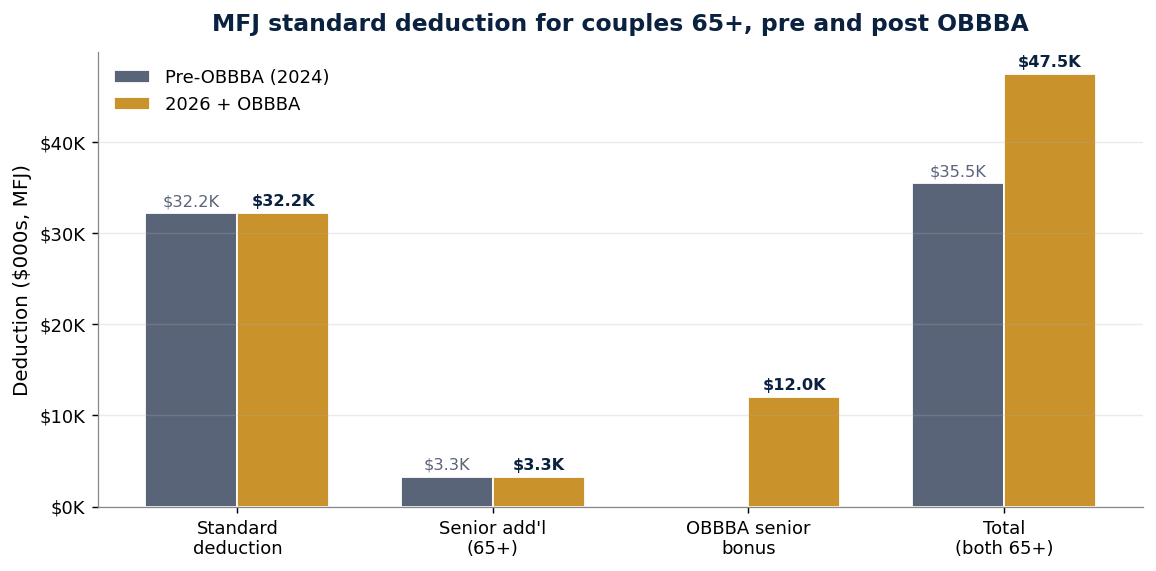
Each $6,000 bonus shrinks by 6 cents for each dollar of MAGI above $75,000 single / $150,000 joint. For a couple, each spouse's $6,000 shrinks that way, so the combined $12,000 drops by 12 cents per dollar and is fully gone at $250,000 joint MAGI.
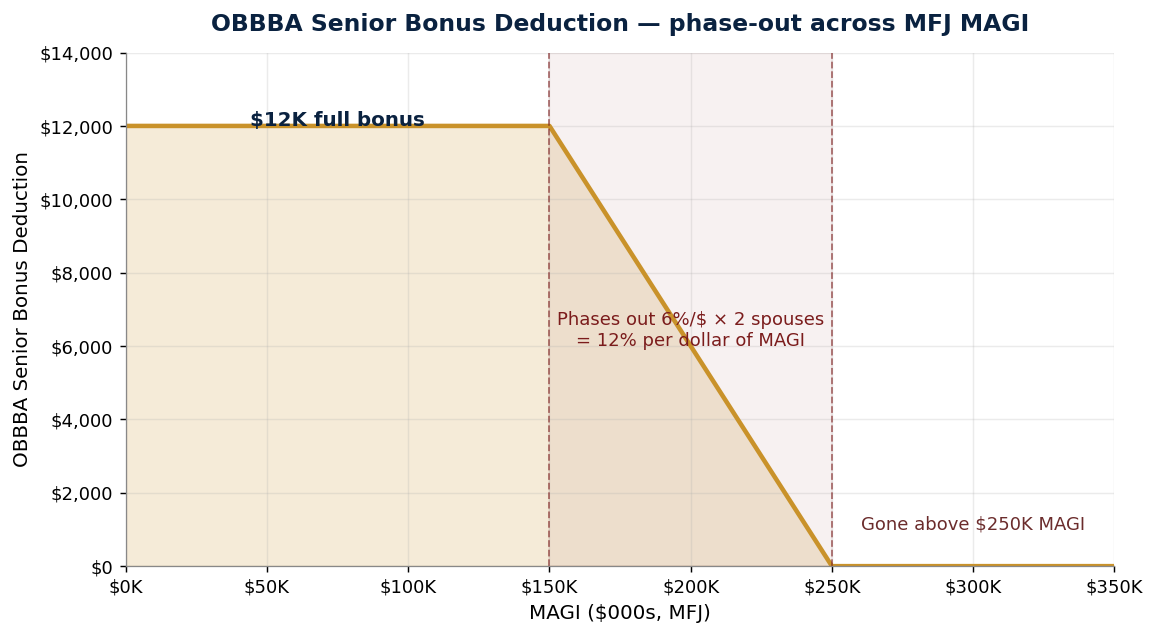
Couples with MAGI under $150K capture the full $12,000. Between $150K and $250K of MAGI, every additional dollar of income removes 12 cents of deduction. In the 22% bracket that adds 2.64 points, so the effective rate on that dollar is about 24.6%. In the 24% bracket it is about 26.9%.
What this means for federal tax owed
Comparing pre-OBBBA and post-OBBBA federal tax owed for an MFJ couple both 65+ at different income levels:
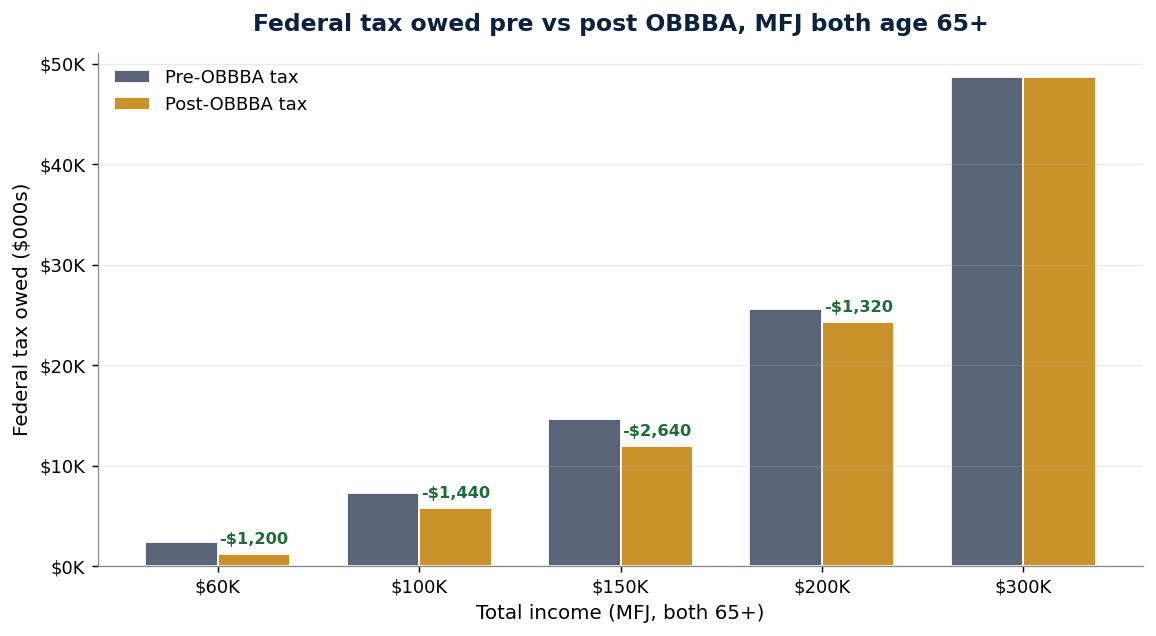
The chart compares 2026 tax with and without the senior deduction, assuming all of the income is taxable. At $60K of total income the couple saves about $1,200 in federal tax ($12,000 at the 10% rate). At $100K, about $1,440 ($12,000 at 12%). At $150K, right at the phase-out edge, the savings peak at $2,640 ($12,000 at 22%). Above $150K the savings shrink as the deduction phases out: about $1,320 at $200K, and nothing at $250K.
For middle-income retirees with total income $60K-$150K MFJ, the senior deduction is worth about $1,200 to $2,640 a year in federal tax, through 2028. For higher-income retirees, the senior-specific savings phase out quickly, but they still benefit from the permanent TCJA brackets, the larger SALT cap, and the permanent estate exemption.
The SALT cap change: relevant for many retirees
The TCJA originally capped the State and Local Tax (SALT) deduction at $10,000 for both Single and MFJ filers. This was particularly painful for high-tax-state residents (California, New York, New Jersey, etc.).
OBBBA raised the cap to $40,400 for MFJ filers in 2026 (and proportionally for other statuses), with phase-down provisions for very-high-income filers and a sunset in 2030 reverting to $10,000.
For California retirees:
- A couple, both 65 or older, pays $15,000 of property tax and $25,000 of California income tax: $40,000 of state and local tax. Under the old $10,000 cap they took the standard deduction, $35,500 in 2026 for a couple both 65+ (IRS, 2026).
- Under the $40,400 cap the full $40,000 counts, so itemizing now beats the standard deduction by $4,500 before any other deductions. At a 24% rate that is about $1,080 less federal tax.
- Once they itemize, charitable gifts and mortgage interest count too. Each extra $1,000 of those saves another $240 at a 24% rate. They still get the $6,000 senior deduction, because it does not depend on itemizing.
This is a meaningful planning shift for any CA, NY, NJ, MA, or similar high-tax-state retiree. The math says re-evaluate your itemize-vs-standard-deduct decision every year through 2029.
The estate exemption: the under-discussed big win
Under pre-OBBBA law, the federal estate tax exemption was scheduled to revert from ~$14M per person in 2025 to roughly $7M per person in 2026 (the pre-TCJA inflation-adjusted level). OBBBA reset the exemption to $15M per person, indexed for inflation, and made it permanent.
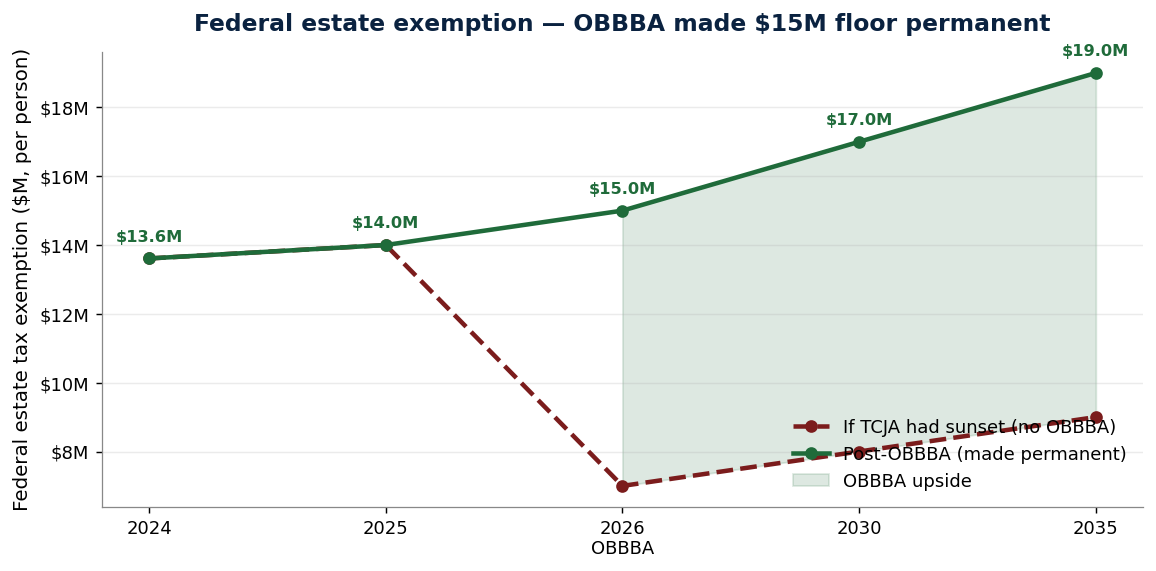
For a married couple using portability, the combined federal estate exemption is now $30M and indexed upward. This effectively removes federal estate tax exposure for the vast majority of American families. Less than 0.05% of estates will face federal estate tax under the OBBBA permanence.
Planning implications:
- Lifetime gifting strategies become less urgent for estates under $30M. The "use it or lose it" pressure from the scheduled 2026 sunset has been removed.
- Irrevocable trusts become more focused on liquidity and asset protection rather than estate tax minimization for most families.
- The income-tax-focused estate planning becomes dominant. Inherited IRA 10-year rules, step-up basis on brokerage, and Roth conversion timing matter more than federal estate tax minimization for most retirees.
- State estate tax planning still matters in 12+ states. California is NOT one of them (no state estate tax), but New York, Massachusetts, Washington, Oregon, and others have state-level estate taxes with much lower exemptions ($1M-$7M).
The 199A QBI permanence: for retirees with side income
Section 199A (the 20% qualified business income deduction) was scheduled to sunset after 2025. OBBBA made it permanent.
For retirees, this matters in several common scenarios:
- Consulting income in semi-retirement: Schedule C self-employment income qualifies if the activity isn't a "Specified Service Trade or Business" (SSTB), with phase-in limits above $403,500 of joint taxable income in 2026 ($201,750 single; Rev. Proc. 2025-32).
- Rental real estate: qualifies under the Section 199A Safe Harbor (Rev. Proc. 2019-38) if you meet specific requirements (250 hours of rental services, separate books, etc.).
- Royalties: qualify if they're from a qualified trade or business in which you were actively engaged.
- Board fees, advisory income, expert witness fees: typically qualify as consulting income (subject to SSTB rules if applicable).
For a retiree with $50K of qualifying QBI from consulting, the 20% deduction is $10K of federal taxable income removed. At the 22% bracket, that's $2,200 of federal tax saved annually. Made permanent by OBBBA, this is a recurring benefit for retirees with any pass-through income, not a temporary windfall.
How OBBBA interacts with retirement planning
Three planning implications worth thinking about:
1. Roth conversion math is mostly unchanged, but timing matters
The permanence of the TCJA brackets means you no longer have a 2025-sunset urgency to convert. You CAN take a more measured pace. But the senior bonus deduction phase-out at $150K-$250K MAGI creates a new "donut hole" where the effective marginal rate is meaningfully higher than the bracket rate. Conversions sized to stay under $150K MAGI capture maximum advantage. Conversions in the $150K-$250K range pay about 2.6 to 2.9 extra points of effective rate because of the phase-out.
2. Itemize-vs-standard recalculation
The expanded SALT cap, plus the senior bonus deduction, materially change the itemize-vs-standard breakpoint. Many retirees who haven't itemized since 2018 should re-run the math each year through 2029. Charitable bunching strategies become more powerful.
3. Estate planning becomes income-tax planning
The $30M MFJ federal estate exemption removes estate tax for virtually all families. Estate planning attention shifts to income tax mechanics: which assets receive step-up basis, which trigger inherited-IRA 10-year drain, which preserve QBI treatment for heirs, and so on.
The workshop linked below walks through the new OBBBA-era retirement planning framework with specific worked examples.
Free workshop: 2026 Retirement Tax Strategy Under OBBBA
Hans walks through how the senior bonus deduction, SALT cap, and permanent TCJA brackets change the math in his SoCal workshops.
See Upcoming Workshops
Hans Goldstein, EA
Founder & Executive Director · Retirement Literacy Foundation, a 501(c)(3) non-profit
Admitted to practice before the IRS
Want more information on this? Put your name below and I’ll send it over in plain English, at no cost. If your situation has a wrinkle, reply to the email and tell me what it is; I read them.
You’re reading: OBBBA Impact on Retirees 65+: Senior Bonus, SALT Cap, Estate Tax
Free education. The Foundation sells nothing. By submitting you agree to receive free educational emails. We never sell or share your information and you can unsubscribe from any email.